
 EN
EN
Aligning Industrial Capital Investment with Material Substrate Realities
For metal fabricators, engineering workshops, and industrial manufacturing plants, investing in a high-uptime laser cutting machine represents a profound capital allocation decision that directly dictates long-term workshop profitability and throughput. In a highly competitive global machine tool marketplace, selecting the optimal configuration requires a strategic technical analysis that goes beyond looking at initial purchase quotes or generic marketing brochures. A professional machinery evaluation must always begin with an empirical audit of the facility's historical and projected production records, specifically identifying the primary metal substrates, thickness frequencies, and geometric profiles processed on the shop floor. Making an incorrect technology selection can create severe operational bottlenecks, such as severe capacity mismatches, high ongoing maintenance expenditures, or an inability to process specialized non-ferrous and highly reflective alloys safely. Successful procurement managers avoid these hidden operational penalties by systematically evaluating machinery through a comprehensive total cost of ownership matrix, balancing light source specifications with motion mechanics, software intelligence, and structural safety.
Calibrating Fiber Laser Wattage with Metallurgy Profile Frequencies
The most critical engineering component driving baseline machinery costs and processing throughput is the fiber laser power source, which must be perfectly calibrated to a facility's most frequent metal thickness requirements. Premium industrial platforms integrate globally recognized, Tier-1 optoelectronic brands such as IPG, Raycus, or MAX, which feature highly stable wave absorption metrics and robust performance across continuous operations. For fabrication facilities focusing primarily on thin-gauge sheet metal fabrication, decorative arts, or light-duty enclosures, a solid-state entry platform ranging from 1kW to 2kW offers the ideal balance between capital efficiency and low monthly operational utilities. Conversely, expanding commercial job shops handling a versatile mix of structural plate thicknesses require mid-range power architectures between 3kW and 4kW to maintain high-speed linear feed rates without causing heavy dross formation or rough edge topographies. For heavy-duty industrial environments where rapid, thick-plate vaporization is essential, deploying an ultra-high-power configuration of 6kW or greater ensures clean edge topographies, minimizes the localized heat-affected zone, and prevents structural edge deformation.
Evaluating Kinematic Motion Mechanics and Heavy Duty Frame Metallurgy
The long-term processing precision of a high-speed laser cutting machine depends entirely on the synchronized kinematics of its motion control systems, linear bearings, and rotary drive trains. True manufacturing accuracy over decades of continuous multi-shift execution requires a heavy-duty, heat-treated welded steel frame that has undergone extensive thermal stress relief and vibration aging to entirely eliminate internal structural distortion. This rigid mechanical foundation must be paired with premium linear guidance tracks—such as those manufactured by THK or HIWIN—and driven by high-torque, closed-loop servo motor systems from industry leaders like YASKAWA or FUJI. This precise kinematic synchronization prevents microscopic positioning drift caused by high-acceleration mechanical friction, guaranteeing consistent dimensional tolerances when executing complex geometric cutouts. Furthermore, if your production involves structural profiles rather than flat sheets, the system must incorporate pneumatically clamped front and rear synchronous chucks to secure square, rectangular, or hexagonal tubing tightly, eliminating material deflection during high-velocity directional adjustments.
Integrating Automated Cutting Assemblies with Advanced CNC Systems
Maximizing daily factory throughput while mitigating ongoing operational expenditures requires a sophisticated interface between the physical cutting assembly and the underlying CNC software intelligence. Enterprise buyers should prioritize systems utilizing advanced automated cutting heads from established engineering brands like Raytools or Precitec, which incorporate intelligent real-time dynamic autofocusing sensors that adjust focal positions automatically based on material density changes, successfully eliminating manual setup bottlenecks and protecting valuable optical components from back-reflection damage. This advanced hardware must be tightly integrated with robust, industry-standard control software platforms such as Sypcut or WEIHONG, which allow trained operators to manage complex production schedules effortlessly. These smart software layers feature advanced vision-based active obstacle avoidance algorithms that automatically detect material lifting or warped metal profiles during active fabrication cycles, instantly adjusting the vertical motion path of the cutting head to eliminate devastating collision risks without requiring constant human monitoring.
Synthesizing Enclosure Format Configurations and Worktable Automation
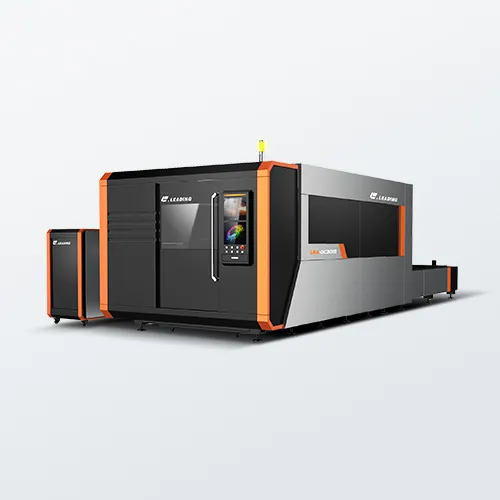
A premium industrial laser cutting machine is never merely an isolated device; its physical configuration must protect your workforce while driving down the overall material handling cycle time. For high-volume manufacturing environments, selecting a full-cover enclosed machine housing is an essential feature, as it completely contains hazardous stray reflections, high-velocity sparks, and metallic fumes within a closed-loop environment that is thoroughly ventilated by zoned dust extraction systems, making compliance with international safety codes straightforward. This robust safety architecture should be seamlessly paired with an automated dual-exchange worktable design, which allows production operators to safely unload finished components and reload raw sheet metal on an external platform while the secondary internal table actively executes high-speed cutting sequences. Consolidating these advanced structural features with verified factory documentation, CE compliance markings, and established direct-to-factory technical guidance transforms the equipment investment into a secure business partnership, allowing fabricators to scale their production capabilities confidently.
Table of Contents
- Aligning Industrial Capital Investment with Material Substrate Realities
- Calibrating Fiber Laser Wattage with Metallurgy Profile Frequencies
- Evaluating Kinematic Motion Mechanics and Heavy Duty Frame Metallurgy
- Integrating Automated Cutting Assemblies with Advanced CNC Systems
- Synthesizing Enclosure Format Configurations and Worktable Automation