
 EN
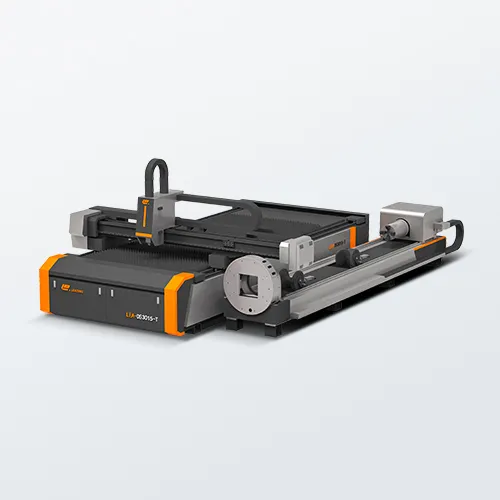
Precision Requirements That Justify a Tube Laser Cutting Machine
Modern manufacturing demands ever-tighter tolerances—especially for load-bearing or safety-critical components. In these contexts, a tube laser cutting machine is not merely advantageous; it’s the only method capable of delivering repeatable sub-millimeter precision that conventional fabrication cannot match. The following scenarios illustrate where this capability shifts from “nice to have” to a non-negotiable production requirement.
Sub-millimeter Accuracy for Complex 3D Tube Profiles
Parts with contoured ends, off-axis holes, interlocking tabs, or complex coped joints often require positional accuracy of ±0.1 mm (0.004″) or better—well beyond the cumulative error thresholds of punch-and-bend or saw-and-mill workflows. These traditional methods introduce compounding inaccuracies, particularly on long or asymmetric tubes. By contrast, a tube laser cutting machine uses closed-loop CNC controls and a servo-driven rotary chuck to maintain cut-path fidelity across full 360° manipulation. This enables precise bevels at any angle, sharp internal corners, and micro-slots—all without secondary deburring.
For medical device frames and electronic enclosures—where minimal heat-affected zones (HAZ) and flawless edge quality are essential—the process routinely holds ±0.05 mm. Crucially, this isn’t a one-off achievement: integrated automated measurement systems and real-time compensation ensure every part in a batch remains within tolerance. The result? Eliminated hand-fitting and up to 40% faster assembly in high-mix environments.
Aerospace Case Study: ±0.05 mm Tolerance in Critical Brackets
An aerospace supplier faced persistent scrap and rework on lightweight structural brackets fabricated from 1.5 mm-wall 6061-T6 aluminum tube. Each bracket required miter cuts, tabbed slots for blind rivets, and an oval harness pass-through—all within a ±0.05 mm tolerance zone. A multi-step punch-bend-weld approach yielded scrap rates above 12%, with frequent dimensional drift.
Switching to a tube laser cutting machine with 3D CAM capability enabled single-setup processing. Dynamic focus control and capacitive height sensing allowed seamless, simultaneous cutting of the oval and slots—holding critical dimensions consistently across a 1,200-unit run. First-article inspection showed no measurable deviation from the CAD model; subsequent CMM data confirmed a process capability (Cpk) exceeding 1.67. Lead time dropped from 8 days to 32 hours, and per-part cost fell by 23%. For high-value aerospace assemblies, sub-0.05 mm accuracy is not aspirational—it’s a strict procurement mandate fulfilled exclusively by tube laser technology.
Production Volume and Part Complexity Thresholds for Tube Laser Cutting Machine Adoption
Manufacturers evaluating a tube laser cutting machine must weigh both annual part volumes and design diversity. While ultra-high-volume, low-variety production still favors punch-bend-weld cells, the economic advantage shifts decisively when complexity and batch variation cross a clear threshold.
Break-Even Point: When 500+ Unique Tube Parts Favor Laser Over Punch-Bend-Weld
Conventional punch-bend-weld workflows demand dedicated tooling, multiple setups, and manual handling for each new profile. At 500+ distinct tube part numbers annually, those fixed costs and changeover minutes rapidly erode margins. A tube laser cutting machine eliminates hard tooling entirely, performs all cuts in a single automatic cycle, and achieves program changeover in under 10 seconds.
A 2023 industry benchmarking study found that for shops processing 500–800 unique tube SKUs, the per-part cost using laser was 28–35% lower than progression press + secondary welding—factoring in tooling amortization and labor. The advantage grows further when parts require multiple angled cuts, slots, or notches: tasks the laser handles inline, eliminating separate milling operations.
Rising Demand for High-Mix, Low-Volume Jobs (23% YoY Growth)
Customer demand for customized, short-run fabricated assemblies is accelerating. A 2024 FabTech survey of contract metal fabricators reported a 23% year-over-year increase in high-mix, low-volume orders—driven by electric vehicle infrastructure, agricultural machinery prototyping, and architectural structures.
Traditional systems struggle to profit from batches of 10–50 units because setup time overwhelms margin. A tube laser cutting machine thrives here: zero tooling cost and instant program recall make low-volume runs as economical as mass production. This flexibility allows job shops to quote aggressively on small orders while preserving gross margins—turning high-mix demand into a strategic growth lever.
Material and Geometric Limitations Where a Tube Laser Cutting Machine Excels
Thin-Wall Stainless Steel and Aluminum: Minimizing Thermal Distortion
Thin-wall stainless steel and aluminum tubes are highly susceptible to heat-induced warping, edge rounding, and cut-side deformation during conventional machining. A tube laser cutting machine mitigates these issues through a tightly focused beam and minimal heat-affected zone (HAZ). By precisely controlling pulse duration, feed rate, and assist-gas pressure, operators maintain localized temperatures low enough to preserve structural integrity—even on walls as thin as 0.5 mm.
The non-contact nature of the process also eliminates mechanical stress, which is critical for soft aluminum alloys prone to scratching or denting. The outcome is clean, burr-free edges that often require no secondary finishing—accelerating downstream assembly and reducing scrap for lightweight, high-stakes components.
Challenging Shapes: Oval, Teardrop, and Off-Axis Cut Geometry Support
Beyond round and square profiles, a tube laser cutting machine excels at processing oval, teardrop, and other asymmetric sections—without custom tooling. Its multi-axis cutting head tilts dynamically to produce off-axis cuts: angled edges, compound bevels, and off-center slots—all while maintaining consistent kerf width and geometric fidelity.
Medical device manufacturers rely on this capability to create angled ports or spiral slots on thin-walled cannulae. Though extreme angles (beyond ~60° from perpendicular) may challenge optical performance due to beam elongation, the system covers the vast majority of industrial geometry requirements—enabling high-mix production with zero hard-tool changeover.
Supply Chain and Lead Time Drivers for Outsourcing to Tube Laser Cutting Services
JIT Strategy: Tier-2 Suppliers Using On-Demand Capacity to Reduce Inventory
Tier-2 suppliers increasingly adopt just-in-time delivery models by outsourcing to certified tube laser cutting services—avoiding the capital investment of an in-house machine. On-demand capacity converts fixed capital expenditure into variable cost, enabling rapid response to fluctuating orders without stocking pre-fabricated blanks.
This shift reduces raw material and finished-goods inventory by up to 40%, freeing warehouse space and working capital—while maintaining sub-±0.1 mm accuracy across short-lead production runs.
FAQ
What industries benefit most from tube laser cutting machines?
Industries such as aerospace, medical devices, and custom fabrication benefit greatly due to their need for precise, high-quality, and complex tubing geometries.
How does tube laser technology maintain precision during production?
Tube laser cutting machines use CNC controls, automated measurement systems, and real-time compensation to ensure precise cuts with minimal deviation.
Is tube laser cutting suitable for low-volume production?
Yes, tube laser cutting machines thrive in high-mix, low-volume jobs as they eliminate tooling setup costs and offer quick program changeovers.
What are the main materials processed by tube laser cutting?
The machines excel with thin-wall stainless steel, aluminum, and other metals prone to heat-induced warping or mechanical stress during conventional machining.
Why do manufacturers outsource tube laser cutting services?
Outsourcing allows manufacturers to adopt flexible just-in-time strategies, saving inventory costs and responding rapidly to fluctuating demands.
Table of Contents
- Precision Requirements That Justify a Tube Laser Cutting Machine
- Production Volume and Part Complexity Thresholds for Tube Laser Cutting Machine Adoption
- Material and Geometric Limitations Where a Tube Laser Cutting Machine Excels
- Supply Chain and Lead Time Drivers for Outsourcing to Tube Laser Cutting Services
-
FAQ
- What industries benefit most from tube laser cutting machines?
- How does tube laser technology maintain precision during production?
- Is tube laser cutting suitable for low-volume production?
- What are the main materials processed by tube laser cutting?
- Why do manufacturers outsource tube laser cutting services?