
 EN
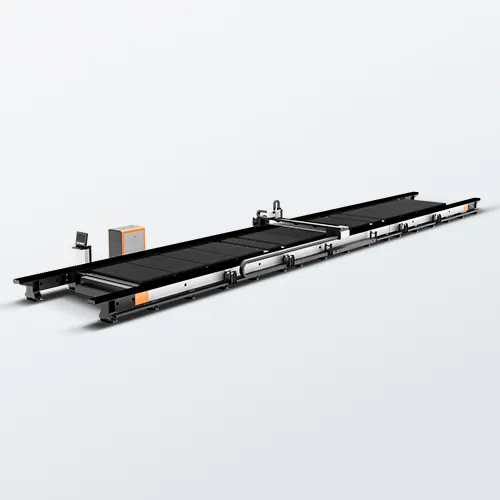
Performance and Precision of Your Laser Metal Cutter
Beam Quality, Cut Accuracy, and Real-World Tolerance Benchmarks
Beam quality is the foundation of a laser metal cutter’s ability to hold tight tolerances in production. A stable laser source—paired with rigid motion components such as servo motors, precision reducers, linear rails, and ball screws—minimizes thermal drift and maintains consistent spot focus on reflective or thick materials. Advanced fiber laser systems typically deliver positioning accuracy of ±0.05 mm and repeatability of ±0.03 mm—roughly one-fourth the width of a human hair. In real-world production, these systems routinely achieve cut tolerances within ±0.1 mm, compared to ±0.5 mm for conventional mechanical or plasma cutting—reducing rework, fit-up time, and downstream assembly cost (Fabricators & Manufacturers Association, 2025).
When evaluating domestic or overseas manufacturers, request beam parameter product data and physical cut samples at your most common material thicknesses. For sheet metal under 6 mm, a 1500 W–3000 W fiber laser generally offers the best balance of edge quality, speed, and operating cost. While higher-power systems (12 kW–40 kW) improve throughput on thick plate, actual tolerance performance depends more on motion system stiffness, optical focus stability, and control software intelligence than raw wattage alone. Manufacturers that provide documented kerf width, edge squareness, and repeatability metrics from actual part runs—not just lab test conditions—offer stronger evidence of real-world capability than catalog specifications alone.
Total Cost of Ownership for a Laser Metal Cutter
Upfront Price, Logistics, Duties, and Integration Expenses Compared
Total cost of ownership (TCO) is a far more reliable decision metric than sticker price. An overseas-sourced laser cutter may appear less expensive upfront, but freight, customs duties, port handling fees, import bonds, and extended lead times often erase that advantage—and sometimes reverse it. Domestic sourcing typically reduces logistical complexity, accelerates installation, and simplifies compliance with local electrical, safety, and emissions requirements.
| Cost category | Domestic sourcing | Overseas sourcing |
|---|---|---|
| Upfront equipment | Higher base price, shorter lead time | Lower quoted price, longer lead time |
| Logistics and duties | Minimal freight, no import duty | Ocean/air freight, customs bond, potential tariffs |
| Integration | Faster local service, simpler electrical and safety compliance | Extra calibration, possible documentation and language gaps |
| Ongoing risk | Easier parts availability | Potentially longer mean time to repair (MTTR) if remote support is limited |
Maintenance accounts for 10–15% of five-year TCO (industry data, 2022). Entry-level 1–2 kW systems range from $25,000 to $45,000; mid-range 6 kW machines start around $120,000; and high-end 12 kW+ systems exceed $180,000 (2026 industry estimates). Over five years, a 6 kW fiber laser system—including energy, assist gas, consumables, and maintenance—typically costs $180,000–$220,000. That’s 40–50% less than an equivalent CO₂ system, largely due to lower power consumption and reduced gas and optics maintenance.
After-Sales Support and Uptime Reliability for Laser Metal Cutter Operations
Mean Time to Repair (MTTR), Local Technician Availability, and Remote Support Limits
For a laser metal cutter, after-sales responsiveness often determines whether a minor fault becomes a day-long stoppage. Mean Time to Repair (MTTR) measures the average duration from failure report to full restoration of production. According to 2023 field service benchmarks, domestic providers with regional parts inventories consistently achieve MTTR of 4–8 hours. By contrast, overseas-sourced systems relying on international shipping frequently face MTTR of 48–72 hours—or longer—if customs clearance or part backorders intervene.
| Support variable | Domestic provider | Overseas provider |
|---|---|---|
| Typical MTTR | 4–8 hours if local parts inventory exists | 48–72 hours when parts must ship internationally |
| Local technician availability | Same-day or next-day on-site service in major manufacturing regions | Limited; may rely on third-party contractors or fly-in engineers |
| Remote support ceiling | Can resolve roughly one-third of faults via diagnostics, but mechanical or optical issues still require a visit | Similar remote diagnostics, but time-zone delays and language barriers can slow escalation |
Field service data from leading laser equipment providers shows remote diagnostics resolve 30–40% of control-level faults—such as parameter mismatches or software alarms—without dispatching a technician. However, beam alignment, lens contamination, chiller faults, and motion system wear demand physical intervention. The real uptime difference lies not in whether remote support exists, but in how quickly a qualified technician can arrive with the correct spare part. Domestic supply chains shorten this loop: regional warehouses and certified field engineers reduce both travel time and parts wait. Overseas support can be reliable—but only with proactive buffer stock of critical consumables and a clearly defined escalation path for on-site service.
Customization, Compliance, and Industry-Specific Readiness
Alignment with Local Standards (GB/T) and Material-Specific Laser Metal Cutter Calibration
A domestically supplied laser metal cutter typically ships with documentation, presets, and control logic aligned to China’s GB/T standards—including GB/T 34380-2017 for laser cutting machines. Overseas equipment may carry CE or ISO certifications, but it often requires local revalidation for GB/T audits, buyer acceptance, or provincial safety inspections. This compliance gap most commonly surfaces during material-specific calibration, not paperwork.
Domestic suppliers routinely pre-tune cutting tables for mild steel, stainless steel, aluminum, brass, and copper across standard thickness ranges—reducing manual adjustments to focus, gas pressure, and feed rate. For example, switching from 3 mm carbon steel to 2 mm aluminum changes pierce timing, assist gas type (N₂ vs. O₂), and nozzle standoff—settings that a preloaded parameter library handles automatically, minimizing scrap during ramp-up. Buyers serving automotive, sheet metal fabrication, or medical device subcontracting should request a documented calibration matrix with tolerance benchmarks. Compliant, material-ready settings are often the fastest route to first-article approval—and the strongest indicator of operational readiness.
FAQs
-
What is the significance of beam quality in laser metal cutting?
Beam quality is crucial for achieving tight tolerances in production, enabling precise cuts with minimized thermal drift and consistent spot focus.
-
What should I ask when selecting a laser metal cutter manufacturer?
Request beam parameter product data and physical cut samples at commonly used material thicknesses. Manufacturers should provide detailed evidence of real-world tolerance capabilities.
-
How does sourcing affect the total cost of ownership?
Domestic sourcing typically offers a simplified logistical process, quicker installation, and reduced compliance challenges compared to overseas sourcing.
-
What is the Mean Time to Repair (MTTR) for laser cutters?
Domestic providers with regional part availability can achieve MTTR of 4–8 hours, while overseas providers may face MTTR of 48–72 hours due to international shipping delays.
-
Why is customization important for laser metal cutters?
Proper customization ensures compliance with local standards and allows for material-specific calibration, which can reduce scrap and improve production efficiency.