
 EN
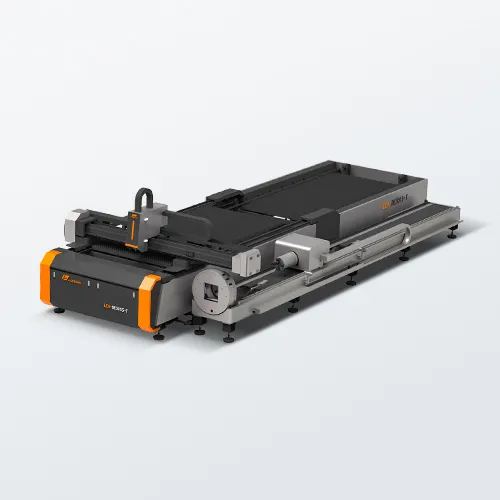
Precision and Quality: Why Fiber Laser Cutters Excel on Thin to Medium Metals
Tighter Tolerances, Narrower Kerf, and Superior Edge Finish (Up to 19mm)
Fiber laser cutters deliver an exceptionally focused beam with low divergence—producing a small, stable spot that yields narrow kerfs, minimal taper, and sharp, repeatable features. On thin to medium metals up to 19 mm, this translates to dimensional tolerances of ±0.05–0.20 mm and edge roughness low enough to eliminate or reduce secondary grinding and deburring. In contrast, plasma cutting typically produces wider kerfs, more pronounced bevels, and visible dross—especially on thinner sheets.
For example, a 6 kW fiber laser cuts 5 mm stainless steel at 4.5–5 m/min—nearly twice the speed of a comparable CO₂ system—while delivering smoother edges than plasma on the same material. The near-circular, stable beam ensures consistent hole piercing, fine contours, and acute corner definition across the entire sheet. The narrow cut channel also improves nesting efficiency, reducing raw material waste by up to 25%. On thin-gauge metal, feed rates can reach 20 m/min—enabling intricate slots, profiles, and geometries that plasma would struggle to reproduce without post-processing like hand finishing, straightening, or rework. For many fabricators, this level of edge quality allows parts to move directly from cutting to bending, welding, or coating—removing an entire production step.
Higher Uptime and Lower Per-Part Cost in High-Mix, Low-Volume Production
Fiber laser systems excel in high-mix, low-volume environments because material and thickness changeovers are fast, predictable, and largely automated. Modern control systems minimize manual intervention—reducing setup time, extending uptime, and supporting continuous operation across diverse jobs. Unlike plasma systems—which require frequent electrode and nozzle replacements, along with periodic gas-flow recalibration—fiber lasers have fewer consumable touchpoints in the cutting head, enabling longer uninterrupted runs.
The combination of tighter nesting (cutting waste reduced by up to 25%), superior edge quality (cutting deburring and straightening time), and high thin-sheet speeds (up to 20 m/min) lowers per-part cost significantly. Even small batches complete quickly, improving cash flow and reducing work-in-process inventory. When switching between materials—say, from 1 mm aluminum to 10 mm mild steel—parameter libraries and automatic focus control streamline setup. As a result, fiber laser becomes more economical than plasma for most parts under ~19 mm, especially where precision, repeatability, and surface integrity matter.
Material Compatibility: Fiber Laser Cutters Handle Reflective Metals with Ease
Material compatibility is often the first filter when selecting a laser metal cutter—particularly for shops working regularly with copper, brass, or aluminum. These non-ferrous metals pose challenges for conventional methods due to their high reflectivity and thermal conductivity.
Copper, Brass, and Aluminum—No Arc Instability or Reflected Beam Risk
Fiber lasers operate at a ~1-micron wavelength—well within the absorption band of copper, brass, and aluminum—creating a stable, efficient cutting front. By contrast, CO₂ lasers emit at 10.6 microns, a wavelength highly reflective off these metals; unmanaged back reflections can damage optics or destabilize the resonator. Fiber lasers route energy through a sealed optical fiber, containing and safely dissipating any reflected light.
Plasma cutting relies on an electric arc between electrode and workpiece—a process vulnerable to arc instability on highly conductive metals. On copper or brass, the arc tends to wander, widening the kerf and forcing speed reductions. Fiber lasers eliminate this entirely: no electrode, no arc, no risk of nozzle short-circuiting or start-up failures. That stability makes fiber the preferred choice for repeatable, high-yield production of reflective non-ferrous parts.
Reduced Heat-Affected Zone and Minimal Distortion vs. Plasma
A fiber laser concentrates energy into a spot often under 100 microns—limiting heat diffusion and producing a narrow heat-affected zone (HAZ). Plasma uses a high-temperature arc and forced gas flow, injecting significantly more thermal energy into the workpiece. On thin aluminum, copper, or brass, this excess heat commonly causes warping, edge rounding, or oxidation discoloration. The tighter HAZ from fiber cutting preserves mechanical properties near the edge and reduces or eliminates the need for post-cut straightening or machining.
In precision sheet metal applications, the difference is evident: flatter parts, cleaner holes, and improved fit-up before welding. While plasma remains effective on thick carbon steel, fiber laser consistently delivers lower distortion and higher edge fidelity on reflective non-ferrous metals up to ~19 mm—making it ideal for delicate, high-value components.
Thickness Thresholds and Operational Economics: Knowing When to Choose Each Laser Metal Cutter
The 19–25mm Crossover Point: Where Plasma Regains Speed and Cost Advantage
Below 19 mm, fiber laser generally dominates in accuracy, edge quality, and throughput. Between 19 mm and 25 mm, however, the balance shifts. While fiber lasers can still cut 20–25 mm mild steel, cutting speed drops markedly and assist gas consumption rises—eroding the economic advantage. Plasma maintains faster travel speeds and lower per-meter consumable costs on thicker sections.
This crossover is where operational economics begin to favor plasma—especially for simple profiles that don’t demand laser-level tolerances. If a part requires tight slots, sharp internal corners, or minimal dross, fiber remains justified up to ~25 mm. Material type matters too: aluminum and stainless may extend the fiber advantage slightly, as plasma’s edge oxidation often necessitates extra cleaning or grinding. For long straight cuts, bolt-hole patterns, or heavy weld preps, plasma frequently delivers acceptable quality at substantially lower operating cost.
The right decision hinges not on machine price alone—but on cut speed, edge squareness, post-cut grinding time, and total cost per finished part.
Total Cost of Ownership: Upfront Investment vs. Long-Term Gains for Your Laser Metal Cutter
A fiber laser metal cutter typically requires higher initial capital than plasma equipment—but the true comparison lies in total cost of ownership (TCO). System and installation costs range from $150,000 to $500,000, depending on power, automation, and support infrastructure. Yet high-precision systems commonly deliver 150–200% ROI over three to five years, with payback occurring in 12–18 months for high-volume shops and up to 24 months for smaller or high-mix operations, according to 2024 industry TCO benchmarks.
Long-term gains stem from lower consumable use, less rework, reduced material waste, and higher throughput. Many fabricators report 10–15% less material waste within six months, and about a 20% increase in daily production capacity. Annual maintenance typically runs near 5% of the initial investment, while lifecycle analyses show roughly 20% TCO savings versus traditional cutting methods over the equipment’s service life.
| Cost or Value Driver | Typical Range |
|---|---|
| Initial system and installation cost | $150,000–$500,000 |
| Annual maintenance | ~5% of initial investment |
| Material waste reduction in first 6 months | 10–15% |
| Daily production capacity increase | ~20% |
| Payback window | 12–24 months |
| 3–5 year ROI | 150–200% |
| Lifecycle TCO savings vs. traditional cutting | ~20% |
Higher-spec machines and robust service networks may carry a steeper upfront cost—but they mitigate downtime risk and help preserve residual value. For most metal fabricators, the fiber laser metal cutter proves the lower-cost option—not at purchase, but over years of reliable, high-quality production.
FAQ
What metals are best suited for fiber laser cutters?
Fiber laser cutters excel at cutting thin to medium metals such as stainless steel, aluminum, copper, and brass. They offer high precision and superior edge quality, especially with reflective non-ferrous metals.
How does fiber laser cutting compare to plasma cutting?
Fiber lasers provide tighter tolerances, reduced heat-affected zones, and superior edge finishes when compared to plasma cutting. They are particularly preferred for thin to medium sheet metals and high-precision applications.
What is the maximum thickness fiber lasers can handle efficiently?
Fiber lasers efficiently cut metals up to around 19 mm thickness. Beyond that, plasma cutting often becomes more economical for thicker metals, especially between 19 mm and 25 mm.
What are the cost advantages of using fiber laser cutters?
Although the upfront cost is higher, fiber laser cutters provide cost advantages in the long term through reduced material waste, less rework, and higher throughput. Many shops report achieving ROI within 12-24 months of usage.
How does a fiber laser cutter handle reflective metals?
Fiber lasers operate on a ~1-micron wavelength, avoiding issues like back reflections and arc instability. This makes them ideal for reflective metals like copper, brass, and aluminum.
Table of Contents
- Precision and Quality: Why Fiber Laser Cutters Excel on Thin to Medium Metals
- Material Compatibility: Fiber Laser Cutters Handle Reflective Metals with Ease
- Thickness Thresholds and Operational Economics: Knowing When to Choose Each Laser Metal Cutter
- Total Cost of Ownership: Upfront Investment vs. Long-Term Gains for Your Laser Metal Cutter
- FAQ