
 EN
EN
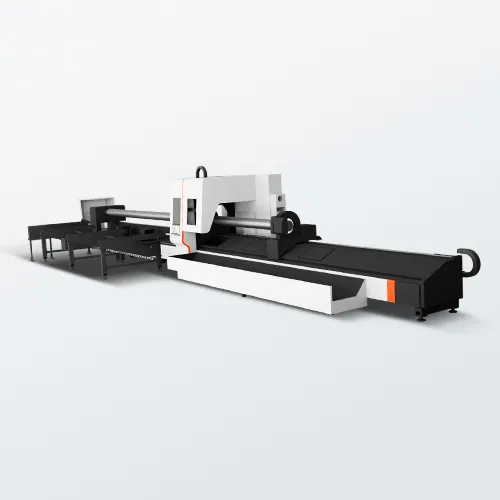
Core Technology: How Fiber Laser Cutters Generate and Deliver Light
Fiber Amplification & Resonator Physics: From Pump Diodes to Coherent Beam Output
The cutting power of a fiber laser originates from light amplification within a specialized optical fiber. High-power pump diodes convert electrical energy into light, which is injected into a silica-glass fiber doped with ytterbium ions. As this light travels through the doped core, it excites ytterbium electrons; when those electrons return to their ground state, they emit additional photons via stimulated emission—a controlled chain reaction that produces an intense, coherent beam at ~1.06 µm. This fiber-based resonator architecture achieves electro-optical efficiency exceeding 30%, far surpassing legacy CO₂ lasers. As explained in Understanding the physics behind fiber laser cutting technology, this process yields a stable, high-brightness beam ideally suited for reflective metals like aluminum and stainless steel.
Beam Delivery Pathway: Collimation, Focusing, and CNC-Guided Optics for Precision Metal Cutting
Once generated, the beam travels to the cutting head via a flexible fiber optic cable—eliminating alignment-sensitive mirror banks and ensuring long-term optical stability. Inside the cutting head, a collimating lens first renders the diverging beam parallel, preserving wavefront uniformity. A focusing lens then concentrates this collimated light into a micron-scale spot with extreme energy density. Final precision is governed by a CNC system that synchronizes head motion with laser modulation in real time. This integrated optical-mechanical pathway delivers narrow kerfs, minimal heat-affected zones, and high repeatability—even on thin sheets processed at high speeds—ensuring digital design intent translates faithfully into physical parts.
The Complete Cutting Process: From CAD to Clean-Edge Metal Parts
Workflow Stages: Design Import → Nesting → Parameter Optimization → Laser Metal Cutter Execution
Every cut begins with a precise CAD model defining geometry, material, and tolerances. That file is imported into CAM software, where it’s converted into G-code—the machine-readable instructions guiding the laser path. Next, nesting software arranges multiple parts on a sheet to maximize material utilization and reduce waste—a direct lever on cost and throughput. Operators then fine-tune parameters (laser power, speed, focal position) based on alloy and thickness: for example, 2 mm stainless steel requires lower power and higher speed than 6 mm mild steel. Finally, the CNC-guided laser executes the program with micron-level accuracy, producing dross-free edges and tight dimensional control—without tool contact or mechanical stress.
Assist Gas Dynamics: How N₂, O₂, and Compressed Air Shape Speed, Dross, and Edge Quality
Assist gas choice defines the cutting mechanism—and critically impacts speed, edge quality, and downstream processing. Nitrogen acts inertly, blowing molten metal from the kerf while preventing oxidation. It yields bright, oxide-free edges ideal for welding or painting—especially on stainless steel and aluminum—though at slightly reduced speeds. Oxygen reacts exothermically with mild steel, boosting thermal input and increasing cut speed by 25–35% on 3 mm stock—but leaves an oxidized, rougher edge requiring cleaning. Compressed air offers a cost-effective middle ground: acceptable edge quality for non-critical parts, with marginally higher burr. Field data from leading manufacturers ranks performance as follows:
| Assist Gas | Typical Speed (1 mm mild steel) | Edge Oxidation | Best Application |
|---|---|---|---|
| Nitrogen | 18 m/min | None | Stainless, aluminum, cosmetic parts |
| Oxygen | 25 m/min | Moderate | Thick mild steel, structural work |
| Compressed air | 20 m/min | Slight | Thin steel, non‑critical components |
Selecting the right gas is therefore a deliberate trade-off among throughput, edge finish, and post-processing cost.
Why Fiber Laser Cutters Dominate Modern Metal Fabrication
Quantified Advantages: 40% Faster Cutting on 1–6 mm Mild Steel vs. CO₂ (2026 Benchmark)
Fiber lasers cut 1–6 mm mild steel 40% faster than CO₂ lasers—a consistent benchmark across global shop floors in 2026. This advantage stems not from raw power alone, but from superior absorption: the ~1.07 µm wavelength couples more efficiently into metal surfaces. Even entry-level 6 kW fiber systems cut thin stainless steel at triple the speed of comparable CO₂ units. At the high end, 40–60 kW machines cleanly sever 50 mm carbon steel—securing fiber’s leadership where throughput is critical. By 2025, fiber lasers accounted for over 60% of global laser cutting installations. Productivity gains translate directly to cost savings: bench tests on 3 mm mild steel show fiber reduces secondary grinding by 50%, thanks to its small kerf and stable beam. Contract fabricators now quote 30–40% shorter lead times—making fiber lasers an operational necessity in competitive metal fabrication.
Energy Efficiency, Low Maintenance, and Seamless Automation Integration with Smart Factories
Modern fiber lasers achieve wall-plug efficiencies above 45%, compared to ~30% for CO₂ systems. A 12 kW fiber laser draws roughly the same grid power as a 7 kW CO₂ unit—yet delivers higher effective output, often halving electricity costs. Their solid-state design eliminates mirror alignment, gas refills, and tube replacements; scheduled maintenance drops by 70%, and unplanned downtime falls below 2%. This reliability enables robust automation: robotic loading, AI-driven path optimization, and real-time parameter adjustment support lights-out production. Integrated via IoT gateways with ERP systems and digital twins, fiber lasers push material utilization up to 18% and defect rates under 0.5%. The convergence of low energy use, minimal intervention, and seamless data flow makes them the foundational platform for high-mix, high-volume, autonomous metalworking operations.
Fiber Laser vs. Alternatives: Real-World Suitability for Metal Cutting Applications
For modern fabrication shops, selecting the right cutting method is a strategic decision affecting cost, quality, and throughput. While fiber lasers dominate high-precision, thin-to-medium gauge metal applications, understanding their fit relative to plasma, waterjet, and other laser types ensures optimal ROI. The decision hinges on material type, thickness, required precision, and total operating cost.
Fiber lasers uniquely excel with reflective metals—aluminum, copper, brass—where CO₂ lasers struggle. Plasma remains practical for thick plate steel beyond 30 mm, but sacrifices edge quality and accuracy. On 6 mm mild steel, fiber cuts up to 4× faster than plasma; flame cutting is impractical due to slow speeds and poor edge integrity. Key comparative attributes are summarized below:
| Technology | Primary Material Suitability | Thickness Range (Mild Steel) | Precision & Edge Quality | Relative Operating Cost |
|---|---|---|---|---|
| Fiber Laser | Reflective & non-reflective metals (stainless steel, aluminum, brass) | Up to ~30 mm | Excellent (minimal dross, narrow kerf) | Low energy use, minimal maintenance |
| CO₂ Laser | Non-metals (wood, acrylic), steel cutting in legacy setups | Up to ~25 mm | Good on thick non-metals | High energy use, complex beam path maintenance |
| Plasma (HD) | Mild steel, thick plate | From ~2 mm to 50+ mm | Moderate (some dross, wider kerf) | Consumable costs, lower capital expense |
| Waterjet | Any material (composites, stone, glass, metals) | Up to 200+ mm | No thermal distortion, moderate precision | Abrasive and pump maintenance costs |
The fiber laser’s shorter wavelength enables a smaller focal spot—resulting in narrower kerfs and reduced heat-affected zones. This yields clean, ready-to-use edges that frequently eliminate secondary finishing. In contrast, plasma’s broader thermal input risks warping thin sheets and demands post-cut grinding. As a result, fiber lasers have become the dominant solution for sheet metal fabrication—delivering high-quality parts, high throughput, and low total cost of ownership.
FAQ
What makes fiber laser cutters more efficient than CO₂ lasers?
Fiber lasers boast greater efficiency due to their shorter wavelength (~1.06 µm) that couples better with metals and their electro-optical efficiency exceeding 30%, reducing energy consumption while maximizing performance.
How does assist gas impact fiber laser cutting?
Assist gas helps shape the cutting mechanism. Nitrogen provides oxide-free, clean edges, oxygen enhances cutting speed with mild steel, and compressed air balances cost and quality for non-critical applications.
What materials and thickness are ideal for fiber laser cutting?
Fiber lasers excel at cutting reflective and non-reflective metals like stainless steel, aluminum, and brass, with a thickness capability of up to ~30 mm for mild steel.
How do fiber lasers integrate with automation systems?
Fiber lasers integrate seamlessly with smart factory automation, including robotic loading, AI path optimization, and IoT-enabled systems for real-time monitoring and high-efficiency production workflows.