
 EN
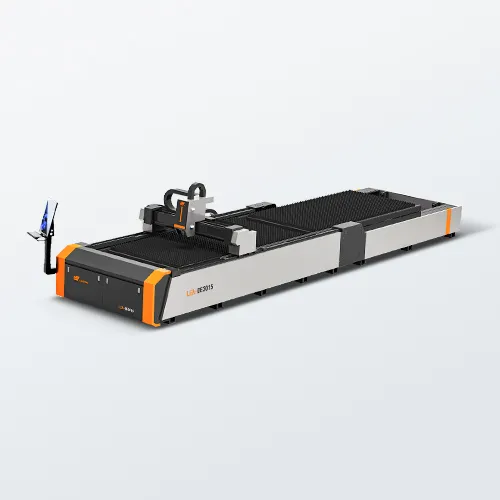
Material Thickness and Laser Power: Key Thresholds for Metal Cutting
Choosing the right laser metal cutter power starts with matching energy density to material type and thickness. The benchmarks below apply to common fiber laser sources in metal fabrication.
Empirical Power–Thickness Benchmarks: Mild Steel, Stainless Steel, and Aluminum (1 kW–6 kW Range)
A 3 kW fiber laser cuts mild steel up to 20–25 mm at 0.55–0.65 m/min, stainless steel up to 10–12 mm at about 1.2 m/min, and aluminum up to 6–8 mm at roughly 2.0 m/min. These values assume optimized assist gas—oxygen for carbon steel and nitrogen for stainless or aluminum. The table below summarizes typical thresholds.
| Material | Max Thickness at 3 kW | Cut Speed (m/min) | Recommended Power Range |
|---|---|---|---|
| Mild Steel | 20–25 mm | 0.55–0.65 | 1.5–6 kW |
| Stainless Steel | 10–12 mm | ~1.2 | 1.5–4 kW |
| Aluminum | 6–8 mm | ~2.0 | 1.5–3 kW |
Higher power expands these limits: a 6 kW source commonly cuts mild steel beyond 25 mm, and 12 kW systems handle structural plate. But rated power alone does not guarantee clean edges; beam quality—often measured as M² ≤ 1.3—is critical for focusing energy into a tight spot and achieving deeper penetration. For aluminum, the same 3 kW source reaches only 6–8 mm because the metal reflects incident energy and conducts heat away rapidly. In practice, many fabricators pair 3–6 kW fiber lasers with automated gas controls to maintain edge quality across these material types.
Why Non-Metals Are Misleading: Acrylic, Wood, and MDF Require Far Less Power—But Aren’t Relevant for Laser Metal Cutter Applications
Thickness charts for acrylic, wood, and MDF often show a 0.5–2 kW CO₂ laser cutting acrylic up to 25 mm and wood or MDF up to 20 mm. Those numbers can mislead buyers evaluating metal cutting equipment, because fiber laser sources used for metal operate at 1.5–6 kW and emit a 1 µm wavelength that non-metals absorb poorly. Acrylic and wood absorb 10.6 µm CO₂ light well but reflect or transmit fiber laser energy. Therefore, non-metal benchmarks should not drive power selection for metal cutting tasks.
Material Properties That Dictate Power Needs for a Laser Metal Cutter
A laser metal cutter must overcome each alloy’s thermal and optical resistance, so power selection starts with material physics rather than thickness alone.
Thermal Conductivity & Reflectivity: Why Aluminum Demands ~2.5× More Power Than Mild Steel at Equal Thickness
Aluminum’s high thermal conductivity—about 237 W/m·K versus 45 W/m·K for mild steel—pulls heat away from the cut zone faster than the beam can melt the kerf. Although aluminum’s melting point is lower than steel’s, thermal conduction and optical reflection dominate the energy balance. At the same time, aluminum’s reflectivity at 1 µm fiber laser wavelengths often exceeds 90%, while bare mild steel reflects only 60–70%. The combined effect means less energy couples into the workpiece and more of what is absorbed is quickly conducted away from the cut front. This is why a 3 kW fiber laser cuts roughly 12 mm mild steel, but only 4–5 mm aluminum in published cutting parameter charts. At equal thickness, aluminum therefore demands about 2.5× the power—or the operator must accept much slower feed rates and higher assist gas pressure. For thin-gauge aluminum below 2 mm, reflectivity can also cause back reflections that stress unprotected laser optics, so high-power systems often require reflective metal sensors or beam dump protection. These material physics explain why selecting a laser cutting system based only on steel capacity will underpower aluminum jobs.
| Material | Thermal conductivity (W/m·K) | Reflectivity at 1 µm | Relative power demand at equal thickness |
|---|---|---|---|
| Mild steel | ~45 | 60–70% | Baseline |
| Aluminum | ~237 | 90% | ~2.5× |
Surface Condition and Coating Effects: How Oxide Layers or Paint Impact Absorption Efficiency
Surface condition shifts how much beam energy a metal absorbs. A thin oxide layer on steel can improve coupling compared with bright, mirror-like metal, while heavy mill scale may reflect light and extend pierce time. Paint, oil, or galvanized coatings often burn off unevenly, producing edge defects and hazardous fumes. For aluminum, anodizing improves absorption over polished stock. Operators should therefore adjust pierce power, focal position, or cleaning steps based on surface state—not just alloy grade. Oxide thickness, rust, and shop contaminants can change effective power demand by 10–20% even when thickness and alloy are identical.
Balancing Power, Cost, and Throughput in Industrial Laser Metal Cutter Deployment
CapEx vs. Output Trade-Offs: When Upgrading from 3 kW to 6 kW Justifies Itself in High-Mix, Medium-Volume Metal Fabrication
Choosing between a 3 kW and a 6 kW laser metal cutter depends less on peak capability and more on daily part mix. A 3 kW machine handles thin to medium sheet efficiently, often cutting mild steel up to about 12–16 mm and stainless steel up to 10–12 mm at acceptable feed rates. In high-mix, medium-volume fabrication, however, the 3 kW unit may create bottlenecks when jobs alternate between thin sheet and plate. A 6 kW system extends clean cutting to roughly 25 mm carbon steel and 20 mm stainless steel, and it can lift throughput by up to 50% on thin-to-medium stock compared with a 4 kW system. That speed improvement reduces cycle time and spreads the higher capital cost across more parts per shift. The upgrade typically pays off when a meaningful share of scheduled work exceeds 6 mm thickness or when current throughput requires overtime. For mostly thin-gauge, low-volume work, the 6 kW option may be overinvestment unless volume growth is locked in.
Safety, Precision, and Sustainability: The Hidden Limits of Excessive Laser Power
Running a laser metal cutter well above the wattage needed for a given thickness may appear attractive because it raises cutting speed. However, excess power also widens the heat-affected zone (HAZ), which can cause edge oxidation, burr formation, and thermal distortion on thin or heat-sensitive alloys. For example, a 4 kW source cuts 1 mm mild steel at about 25 m/min, while a 10 kW source can exceed 60 m/min—but faster cutting only pays off when focus position, assist gas flow, and nozzle standoff are retuned. Otherwise, the faster beam can reduce edge squareness and increase rework.
Safety risk does not scale only with wattage, but higher power raises the consequences of reflection and beam scatter. Class 4 systems require enclosed beam paths, interlocks, and certified laser safety eyewear. Even a brief reflected beam can cause irreversible eye injury. Excessive power also strains optics, nozzles, and motion systems. Consistent maximum-power use on thin stock accelerates consumable wear and may shorten source life—especially when operators cut beyond the recommended thickness range.
From a sustainability and cost perspective, over-specifying power without matching throughput is hard to justify. A higher-power resonator consumes more electricity and demands stronger cooling and power infrastructure. The rational target is the minimum power that meets edge quality, assist gas cost, and daily cutting volume. For most high-mix shops, selecting equipment near the middle of the material thickness range preserves quality, lowers energy per part, and reduces post-processing.
FAQ Section
- What factors affect the power requirements of a laser metal cutter? Thermal conductivity, reflectivity, material thickness, and the surface condition or coating of the material all play a crucial role in determining the power required for effective metal cutting.
- Why does aluminum require more laser power than mild steel at the same thickness? Aluminum has higher thermal conductivity and reflectivity compared to mild steel, which means it dissipates heat and reflects more laser energy, leading to higher power requirements.
- What are the typical power requirements for cutting mild steel, stainless steel, and aluminum? For mild steel, 1.5–6 kW is recommended, while for stainless steel, it's 1.5–4 kW. Aluminum generally requires 1.5–3 kW, but typically needs more power than the other metals at the same thickness.
- Is higher laser power always better for metal cutting? Not necessarily. Excessive laser power can cause problems such as a wider heat-affected zone, edge oxidation, burr formation, increased thermal distortion, and faster wear of consumable parts.
- How does surface condition impact laser cutting? Surface conditions such as oxide layers, rust, or coatings can impact how much beam energy a metal absorbs. Adjustments in pierce power or additional cleaning procedures may be required for consistent results.
- What is a balanced approach to choosing laser power? The best approach is to select equipment that meets your production needs, offers required edge quality, minimizes assist gas usage, and matches your material thickness range without overloading resources.
Table of Contents
- Material Thickness and Laser Power: Key Thresholds for Metal Cutting
- Material Properties That Dictate Power Needs for a Laser Metal Cutter
- Balancing Power, Cost, and Throughput in Industrial Laser Metal Cutter Deployment
- Safety, Precision, and Sustainability: The Hidden Limits of Excessive Laser Power
- FAQ Section