
 EN
EN
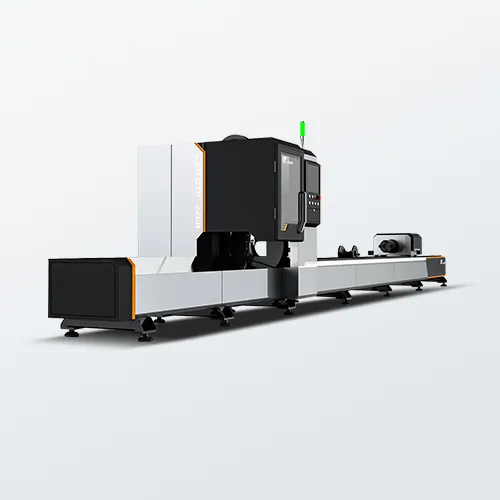
The Imperative for Autonomous High-OEE Manufacturing Environments
In the current industrial landscape, global manufacturing enterprises face unprecedented operational pressures to amplify throughput while systematically mitigating reliance on specialized floor labor. To navigate these microeconomic constraints, forward-thinking fabrication facilities are rapidly replacing legacy mechanical stamping and plasma stations with high-uptime laser metal cutting machine infrastructure to establish fully automated manufacturing workflows. Modern solid-state fiber laser configurations are engineered precisely for this shift toward autonomous execution, integrating sophisticated sub-systems such as automated optical nozzle changers that dynamically adapt to varying material specifications without requiring human intervention. This seamless execution dramatically maximizes overall equipment effectiveness (OEE) and eradicates the traditional setup bottlenecks associated with manual mechanical changeovers. Furthermore, integrated intelligent sensor arrays actively monitor optical components to detect trace particulate contamination before it manifests as structural component failure, successfully eliminating unplanned production downtime and securing predictable asset utilization across consecutive multi-shift schedules.
Transforming Material Volatility into Profitability through Advanced Vision Nesting
Raw material price volatility in global metallurgy sectors introduces severe margin erosion for job shops relying on obsolete mechanical shearing or older gas-based laser systems, which frequently struggle to process irregular leftover sheet metal efficiently. Investing in a professional laser metal cutting machine resolves this critical material efficiency challenge by utilizing highly sophisticated remaining-material layout architectures backed by advanced machine-vision algorithms. Instead of designating irregular scrap boundaries to costly secondary disposal or material recycling, trained operators utilize top-mounted optical scanning arrays to capture the exact spatial coordinate outlines of usable leftover areas with a single digital command. The underlying CNC software layer instantly synthesizes this visual geometry, automatically executing optimized nesting routines for incoming components directly onto the remaining scrap space. This advanced technological capability turns localized scrap into profitable production yields, lowering the dynamic material cost-per-part and optimizing corporate capital efficiency in high-volume production environments.
Mitigating Kinematic Hazards with Predictive Intelligent Collision Protection
As linear cutting speeds and multi-axis dynamic acceleration metrics continue to escalate across automated shop floors, protecting valuable optoelectronic components from physical impact has become a paramount priority for plant managers. During high-velocity execution, localized internal thermal stresses within structural metal sheet or tube stock can cause intricate components to tilt unexpectedly after detachment, presenting catastrophic collision hazards to the traveling cutting assembly. Modern industrial laser metal cutting machine platforms mitigate this mechanical risk by deploying comprehensive over-edge protection architectures driven by closed-loop servo-following sensors and high-speed dynamic path avoidance algorithms. These advanced technical sensors maintain a continuous three-hundred-and-sixty-degree operational barrier around the cutting nozzle, instantly calculating reactive avoidance routes the millisecond an altitude variance is detected. This predictive active protection secures critical equipment investments, giving operations managers complete confidence to run continuous high-uptime fabrication routines without constant human supervision.
Evaluating the Economic Superiority and Low Operating Expenditures of Solid-State Technology
The ongoing industrial migration toward solid-state fiber laser technology is fundamentally justified by its profound thermodynamic and economic superiority over legacy CO2 or traditional thermal arc processes. A premium laser metal cutting machine delivers exceptional electro-optical efficiency metrics that vastly surpass traditional gas-medium lasers, translating directly into significantly minimized monthly utility bills and reduced thermal load dissipation within the factory environment. Furthermore, because the solid-state light source generates its coherent beam within specialized fiber-optic strands, the entire physical architecture contains no internal alignment mirrors, complex gas-mixing chambers, or high-speed vacuum turbines requiring intensive maintenance cycles. Partnering with an established direct-to-factory global manufacturer utilizing premium resonators from trusted engineering brands ensures verified component tracing and complete kinematic reliability, allowing workshops of all sizes to maintain stable processing dynamics across extended multi-shift production cycles.
Scaling Workshop Capabilities with Versatile Material and Geometric Processing Boundaries
Ultimately, a modern CNC laser metal cutting machine functions not merely as an isolated tool, but as the flexible core of a scalable smart factory infrastructure capable of processing diverse metallurgical substrates. Advanced fiber laser platforms handle an extensive spectrum of raw materials—ranging from standard carbon steel and clean stainless alloys to highly volatile, reflective substrates like aluminum, brass, and thick industrial copper plates—without requiring physical tool configurations or secondary machinery setups. Depending on the chosen kilowatt power platform and structural machine bed layout, a single manufacturing asset seamlessly transitions between delicate thin-gauge foils and heavy structural plates. When this multi-material capability is paired with automated dual-exchange worktables or synchronous pneumatic tube-processing extensions, it consolidates multiple traditional secondary manufacturing processes into a single automated system, allowing enterprises to scale their production capabilities confidently and reduce their long-term cost-per-part.
Table of Contents
- The Imperative for Autonomous High-OEE Manufacturing Environments
- Transforming Material Volatility into Profitability through Advanced Vision Nesting
- Mitigating Kinematic Hazards with Predictive Intelligent Collision Protection
- Evaluating the Economic Superiority and Low Operating Expenditures of Solid-State Technology
- Scaling Workshop Capabilities with Versatile Material and Geometric Processing Boundaries