
 EN
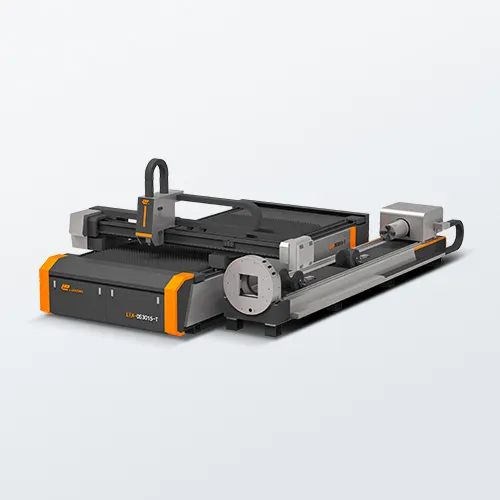
Unmatched Speed and Productivity for High-Volume Metal Production
Throughput gains on thin-to-medium gauge metals
Fiber laser cutting machines deliver substantial throughput gains on thin-to-medium gauge metals—typically 0.5 mm to 6 mm sheet—thanks to superior absorption of the 1.07 µm wavelength by steel, stainless steel, and aluminum compared to the 10.6 µm CO₂ beam. A 3 kW fiber source cuts 1 mm stainless steel at 35–40 m/min, nearly three times faster than a comparable CO₂ system (14–18 m/min), per 2026 industry benchmarks. On 2–3 mm mild steel, fiber speeds remain 1.8–2.5× higher. These advantages compound in nested production: rapid traverse speeds and lower heat input reduce secondary trimming and straightening, enabling high-volume shops to process more sheets per shift—without expanding floor space, labor, or machine count. The benefit is most pronounced in orders with large quantities of small-to-medium parts, where total cut length per sheet is high.
Faster acceleration, shorter piercing times vs. CO₂ lasers
Fiber lasers improve productivity not only through cutting speed but also via faster non-cutting motions. Solid-state fiber sources switch on and modulate within microseconds, achieving full cutting power almost instantly. Piercing 1 mm mild steel takes just 0.2–0.4 second—less than half the 0.6–1.0 second required by CO₂ systems in 2026 trials. For profiles requiring 80–120 pierces per sheet, this saves 40–70 seconds per cycle. Lightweight fiber cutting heads paired with linear-motor gantries accelerate at 2–3 g, reaching full velocity sooner after corners and pierces. Unlike CO₂ resonators, fiber sources need no turbine warm-up or beam-path stabilization between starts—sharpening responsiveness on short, high-frequency cuts and reducing idle time between nested parts. This directly increases laser-on time, a critical KPI in high-volume fabrication.
Real-world case: Automotive supplier cuts cycle time by 42% with a fiber laser cutting machine
A mid-sized automotive components supplier replaced two 4 kW CO₂ laser cutters with a single 6 kW fiber laser cutting machine in 2026. After a four-month ramp-up, average cycle time across brackets, mounts, and seat-frame blanks dropped 42%—from 11.8 minutes to 6.8 minutes per nested sheet. Gains stemmed primarily from faster thin-sheet processing and reduced pierce-to-pierce transitions—not wattage alone. Energy use per part fell by 38%, and scheduled maintenance downtime dropped from nine to three hours monthly. Operators reported less post-cut grinding due to consistent edge quality. The supplier reassigned two employees to downstream welding and assembly, increasing overall line throughput without adding a third shift.
Superior Precision and Edge Quality for Tight-Tolerance Applications
A fiber laser cutting machine delivers the beam stability, small focal geometry, and consistent motion control essential for precision metal fabrication. Two beam-related factors largely determine cut accuracy: beam parameter product (BPP) and focused spot size.
Beam quality (BPP) and focused spot size advantages
Beam Parameter Product (BPP) quantifies how tightly a laser beam can be focused. Single-mode fiber lasers typically operate below 0.4 mm·mrad—far tighter than CO₂ lasers, which range from 3 to 5 mm·mrad. This enables focused spot diameters near 25 µm, roughly one-quarter the size of typical CO₂ spots. The smaller, more concentrated spot dramatically increases power density at the cut front, supporting narrow kerfs, clean edges, and excellent straightness. In 2026 industrial evaluations, fiber lasers maintained stable beam quality even at high output power, minimizing heat-affected zone widths and improving repeatability on tight-tolerance components.
Consistent kerf width, edge squareness, and minimal dross on stainless steel and aluminum
Fiber lasers produce narrow, repeatable kerfs—as small as 0.1 mm on thin stainless steel and aluminum—along with near-vertical cut edges and high edge squareness. Efficient absorption of the 1.07 µm wavelength promotes cleaner molten ejection and significantly less dross attachment on the bottom edge. Production tests from 2026 showed edge angle deviations under 0.5 degrees for both stainless steel and aluminum. That consistency allows fabricators to hold tight dimensional tolerances across long runs without frequent tool changes or manual deburring.
Lower Operating Costs and Higher Uptime: Efficiency, Maintenance, and Reflectivity
A fiber laser cutting machine reduces operating expenses by converting electrical power into cutting energy more efficiently—and demanding far less routine service.
Electrical-to-optical efficiency: 30–50% vs. 8–12% for CO₂
Modern fiber sources achieve 30–50% wall-plug efficiency, compared to just 8–12% for CO₂ lasers (2026 industry benchmarks). This means a fiber system delivers equivalent cutting power using roughly one-third to one-half the electricity. For a 4 kW source, the annual energy cost difference exceeds $3,000 at average industrial rates (2026). Lower power draw also reduces cooling load and peak demand charges—directly lowering utility bills without sacrificing speed or thickness capability. Over time, this efficiency gap meaningfully reduces total cost of ownership.
Minimal maintenance: No resonator mirrors, gas replenishment, or beam alignment
Fiber lasers eliminate core maintenance tasks tied to CO₂ resonator optics and gas circulation: no resonator mirrors to clean or realign, no laser gas to replenish, and no turbo blowers to service. Routine upkeep focuses on protective window inspection, nozzle cleaning, and filter changes. This cuts scheduled downtime by up to 50% versus CO₂ systems in similar production environments (2026). Fewer wear parts also lower annual consumable costs and free maintenance staff for value-added improvements—boosting machine availability and schedule predictability.
Reliable cutting of highly reflective metals—copper and brass—without damage risk
Fiber lasers safely cut copper, brass, and aluminum with markedly lower risk of back-reflection damage than CO₂ platforms. The shorter 1.07 µm wavelength couples more efficiently with these metals, enabling stable cutting at speeds previously unattainable. Many shops now process copper up to 10 mm and brass up to 12 mm with good edge quality (2026). Built-in back-reflection monitoring automatically pauses the beam if reflected energy exceeds safe thresholds—allowing fabricators to take on high-value electrical, busbar, and heat-exchanger work without investing in specialty equipment. The process remains stable even on galvanized steel and other reflective alloys.
Broad Material Versatility Across Industrial Metals
A fiber laser cutting machine processes a wider range of industrial metals than legacy CO₂ systems because its near-infrared wavelength—typically 1.07 µm—is absorbed more efficiently by steel, stainless steel, aluminum, copper, brass, and titanium. This reduces reflectivity-related energy loss and eliminates the back-reflection damage that often limits CO₂ lasers on reflective alloys. As a result, one platform handles carbon steel, galvanized sheet, stainless, aluminum, copper, and brass—reducing reliance on multiple cutting technologies.
| Metal group | Typical fiber laser capability | Key benefit |
|---|---|---|
| Carbon steel | Up to 25 mm with nitrogen or oxygen assist | Fast, clean cuts for structural work |
| Stainless steel | Up to 20 mm | Minimal dross and consistent edge color |
| Aluminum | Up to 12–15 mm | High absorption and lower edge roughness |
| Copper and brass | Up to 8–10 mm | Safe reflective-metal processing |
Modern fiber lasers switch quickly between materials by adjusting focus position, power, and assist gas pressure. This flexibility supports job shops that move from thin aluminum enclosures to thick steel brackets in a single shift—maintaining tight tolerances across alloys without changing resonator settings or beam delivery optics.
Stronger ROI and Lower Total Cost of Ownership Over Time
5-year TCO analysis: Energy savings, consumables, downtime reduction, and labor efficiency
While fiber laser cutting machines often carry a higher initial purchase price, a five-year total cost of ownership (TCO) analysis consistently shows stronger ROI through lower operating expenses. With 30–50% electrical-to-optical efficiency—versus 8–12% for CO₂ systems—energy use per cut drops significantly. Consumables are limited to nozzles and filters; there’s no need for resonator mirrors or laser gas replenishment. Reduced maintenance downtime improves throughput, and faster cutting speeds lower labor hours per part. The table below summarizes key drivers:
| TCO factor | CO₂ laser | Fiber laser |
|---|---|---|
| Energy cost | Higher draw, lower efficiency | 30–50% lower energy use |
| Consumables | Mirrors, gas, bellows | Nozzles, filters only |
| Maintenance downtime | More frequent alignment and service | Minimal routine upkeep |
| Labor per batch | Longer cycle times | Faster throughput reduces hours |
Over five years, these cumulative savings typically offset the higher capital investment—and often deliver net positive ROI well before end-of-life.
FAQ Section
What are the key advantages of fiber laser cutting machines over CO₂ lasers?
Fiber lasers offer significantly faster cutting speeds, greater energy efficiency (30–50% electrical-to-optical efficiency), lower maintenance requirements, and better ability to handle reflective materials like aluminum, copper, and brass without risk of damage.
What materials can fiber laser cutting machines process effectively?
Fiber lasers are versatile, processing a wide range of materials including carbon steel, stainless steel, aluminum, copper, brass, and titanium. These machines can handle metal thicknesses ranging from thin gauges to around 20–25 mm depending on the material.
How do fiber lasers achieve superior edge quality and cut precision?
Fiber lasers maintain a high Beam Parameter Product (BPP) for small, stable focal spots, which result in narrow kerfs, clean edges, and minimal dross. This precision is ideal for tight-tolerance applications.
What are the cost benefits of using a fiber laser cutting machine?
Fiber lasers reduce operating costs through high energy efficiency, minimal consumable requirements, and lower maintenance downtime. Long-term savings often outweigh the higher initial investments.
Are fiber laser cutting machines suitable for high-volume production?
Yes, they are highly efficient for high-volume production due to their fast acceleration, shorter piercing times, consistent edge quality, and ability to process nested sheets quickly.
Table of Contents
- Unmatched Speed and Productivity for High-Volume Metal Production
- Superior Precision and Edge Quality for Tight-Tolerance Applications
- Lower Operating Costs and Higher Uptime: Efficiency, Maintenance, and Reflectivity
- Broad Material Versatility Across Industrial Metals
- Stronger ROI and Lower Total Cost of Ownership Over Time
-
FAQ Section
- What are the key advantages of fiber laser cutting machines over CO₂ lasers?
- What materials can fiber laser cutting machines process effectively?
- How do fiber lasers achieve superior edge quality and cut precision?
- What are the cost benefits of using a fiber laser cutting machine?
- Are fiber laser cutting machines suitable for high-volume production?